Bài mẫu và từ vựng hay đề Writing Cambridge IELTS 15
Cambridge IELTS 15 tương tự như các số khác với 4 đề. Phần thi Writing có Task 1 và Task 2. Các đề được ra trong sách là
| Task 1 | Task 2 | |
| Đề 1 | Table | Mixed/Two-part Question |
| Đề 2 | Line Graph | To what extent do you agree or disagree |
| Đề 3 | Process | Discuss both these views and give your own opinion. |
| Đề 4 | Mix Chart | Advantages - Disadvantages |
Dưới đây sẽ là bài mẫu theo từng test, bạn cùng tham khảo để viết bài nhé. Từ vựng sẽ được chắt lọc để dễ áp dụng hơn.
Writing Test 1
Task 1
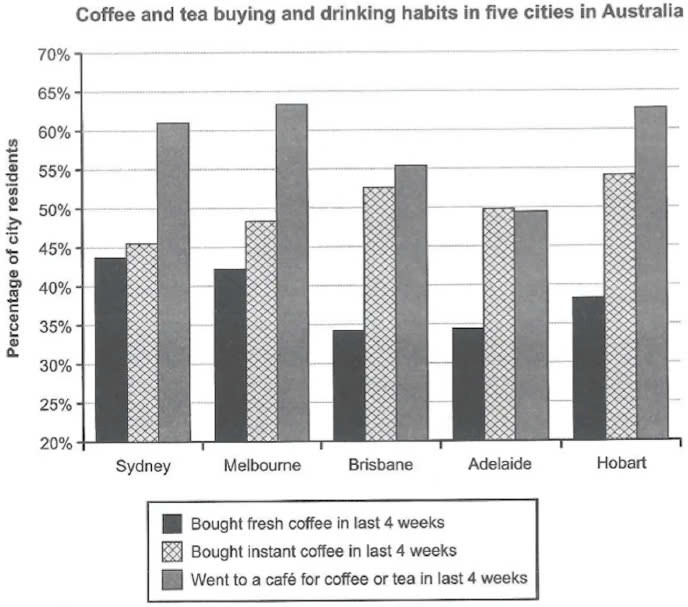
The given bar chart compares the percentages of people living in five cities of Australia who purchased and drank tea and coffee over the last four weeks.
Overall, it is evident that residents in almost every surveyed city were in favor of visiting a cafe for both types of beverages, with Adelaide being the only exception as its people preferred instant coffee. It is also worth noting that fresh coffee was the least popular option in all cities.
In the previous 4 weeks, Sydney and Melbourne saw relatively similar patterns in terms of coffee and tea consuming habits. Around 60-65% of residents in these cities opted for going to a cafe, displaying a staggering discrepancy when compared to the other two options. The percentages of people buying fresh and instant coffee in Sydney were almost identical, hovering around 45%. In Melbourne, fresh coffee was slightly more popular than the instant counterpart, with the figure for the former at 48% and the latter at 42%.
Turning next to Brisbane and Hobart, people in these cities also exhibited comparable tendencies. Taking trips to a cafe remained the most popular habit in Brisbane and Hobart, with the figures standing at 56% and 64%, in turn. Following closely behind, the proportions of people buying instant coffee were 52% in Brisbane and 54% in Hobart and there were remarkable disparities of around 20% between the preference for this and fresh coffee in both places.
Different from the other four urban areas, the habits of buying instant coffee and going to a cafe were practiced equally by city dwellers in Adelaide, with their respective data both claiming 50%.
(272 words)
|
Useful Vocabularies |
|
|
exception |
ngoại lệ |
|
staggering |
rất lớn, kinh ngạc |
|
discrepancy |
sự chênh lệch |
|
identical |
tương đồng |
|
hovering |
dao động nhẹ |
|
counterpart |
cái tương tự (substitution) |
|
former |
subject đứng trước |
|
latter |
subject đứng sau |
|
Useful Structures |
|
|
It is evident that |
Rõ ràng là |
|
It is also worth noting that |
Cũng đáng chú ý là |
TASK 2
In some countries, owning a home rather than renting one is very important for people.
Why might this be the case?
Do you think this is a positive or negative situation?
In certain countries , home ownership is given precedence over renting for people. From my viewpoint, there are several reasons that should be considered for this phenomenon and I believe this situation offers both favorable results and harmful effects for people with different financial statuses.
The first notable aspect can be attributed to unparalleled cost-effectiveness and a sense of financial assurance provided by owning a house. To elaborate, tenants are subject to monthly payments and possible increases in renting rates, engendering pressure in terms of managing the distribution of money. Conversely, self-owned properties serve as personal assets that significantly reduce expenses for people every month. Beside economic problems, another strong point is also associated with concerns about landlords. While renting a home, individuals are inevitably faced with potential unwanted incidents such as conflicts with lessors or unexpected evictions. On the other hand, mental stability and a feeling of security are fostered for people by having their own homes as they are freed from reliance on others.
From my personal perspective, homeownership can be beneficial for people with proper financial development while those struggling might suffer from detrimental consequences. In terms of the former, properties can accumulate in equity over time, fostering an opportunity for people owning houses to gain profit through price appreciation. Thus, such assets can serve as a product of real estate for sale in order to generate additional money. Concerning the latter, forcing oneself to purchase a house with inadequate financial abilities imposes a budgetary burden that can eventually lead to unwanted repercussions. For instance, people with insufficient economic support might have to resort to loaning money from banks to buy houses, inducing risks of default and debt.
In conclusion, people are more likely to purchase houses instead of renting one due to the aspects of cost-effectiveness and mental stability. While this phenomenon provides a number of advantages for affluent people, it can pose a threat for people of lower economic condition.
(325 words)
|
Useful Vocabularies |
|
|
tenant |
người thuê nhà |
|
conflict |
mâu thuẫn |
|
price appreciation |
tăng giá |
|
repercussion |
hậu quả |
|
default |
vỡ nợ |
|
Useful Structures |
|
|
is given precedence over |
được coi trọng hơn |
|
can be attributed to |
có thể được giải thích bởi |
Test 2
Task 1
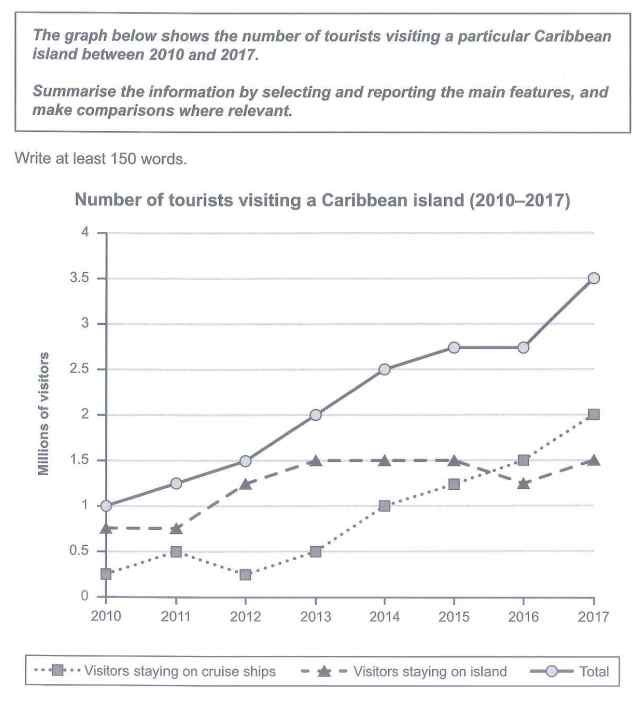
The graph below shows the number of tourists visiting a particular Caribbean island between 2010 and 2017.
Summarise the information by selecting and reporting the main features, and make comparisons where relevant.
Number of tourists visiting a Caribbean island (2010-2017)
Bài mẫu tham khảo số 1:
The line graph illustrates the influx of tourists to a specific Caribbean island and their choice of accommodation over a seven-year period from 2010 to 2017.
Overall, the island experienced a steady increase in tourist numbers throughout the depicted timeframe. Initially, the majority of tourists opted to stay on the island rather than on cruise ships, a trend that persisteduntil 2015 before shifting in the last two years.
In 2010, the island welcomed approximately 1 million tourists, with three-quarters of them choosing to stay on the island itself, while the remainder preferred accommodation on cruise ships. Over the subsequent five years, the preference for on-island stays remained dominant. Notably, the number of tourists staying on the island peaked at 1.5 million in 2013, stabilizing over the following two years. Conversely, the number of tourists opting for cruise ship accommodation fluctuated before reaching around 1.3 million in 2015.
However, a reversal in accommodation preference occurred in 2016 and 2017, with the number of tourists staying on cruise ships surpassing those staying on the island. Specifically, in 2016, approximately 2 million tourists opted for cruise ship accommodation, while around 1.5 million chose to stay on the island. This trend continued in 2017, with similar figures observed.
Bài mẫu tham khảo số 2:
The line graph details the total number of tourists, as well as where they stayed, going to a given Caribbean island from 2010 to 2017.
Overall, total tourists rose considerably, and those staying on cruise ships increased in particular, overtaking staying on the island itself, which underwent a more moderate increase.
Visitors residing on the island during their travels began the period at about .75 million, about 500,000 above those on cruise ships. From there, the numbers for the former climbed quickly to 1.5 million by 2013, a full million higher than the latter at the same time. Then those on the island were relatively steady until the end of the time surveyed, while cruise ship passengers rose steadily, surpassing the former figure midway through 2015 and reaching a peak in 2017 of 2 million.
The progressive patterns for visitors on cruise ships and the island were reflected in substantial gains for overall visitors, which started at 1 million in 2010, grew consistently to 2.7 million in 2015 before plateauing through 2016 and then increasing sharply to 3.5 million by the end of the period.
|
Useful Vocabularies |
|
|
influx |
Sự đổ vào |
|
depicted |
Được mô tả |
|
steadily |
Một cách ổn định |
|
opted |
Lựa chọn |
|
persisted |
Kiên trì |
|
dominant |
Chiếm ưu thế |
|
peaked |
Đạt đỉnh điểm |
|
stabilizing |
Ổn định |
|
fluctuated |
Dao động |
|
reversal |
Sự đảo ngược |
Task 2
In the future, nobody will buy printed newspapers or books because they will be able to read everything they want online without paying.
To what extent do you agree or disagree with this statement?
Give reasons for your answer and include any relevant examples from your own knowledge or experience.
1. Phân tích câu hỏi
Loại câu hỏi:
- Opinion question
- 100% agree / 100% disagree/ balanced view
Phân tích từ chìa khoá:
- printed newspapers or books ~ traditional/ conventional ..
- online ~ on the internet ~ digital books / digitalize
- without pay ~ complimentary ~ free of charge ~ do not need to pay for …
Gợi ý ý tưởng:
BD1:
- Topic sentence: Not agree that all will be available on the internet free of charge
- First reason: Not feasible
Explain: reporters, book writers .. who pay? - Second reason: Not fair
Explain: If available free, be assumed to be not valuable while actually, books …
BD2:
- Topic sentence: Even if this is true, still exist people who want to read paper versions
- First reason: Reading experience
Explain: be addicted to the smell of wood papers, they have a sense of fulfillment when displaying on a bookshelf neatly - Second reason: Counterproductive trend/ development
Explain: Children —> be tempted by …
Elderly people are not always computer-literate
2. Bài mẫu tham khảo
It is anticipated that online reading will soon supplant the traditional way of reading because all news and books will be found on the Internet and readers are not charged any fees at all. I completely oppose this view for the following reasons.
Firstly, I am not persuaded by the idea that all printed books and newspapers will be converted into online versions which are provided to readers free of charge. This seems to be infeasible because if they are free, there will be no funding to pay for reporters who are in charge of seeking valuable news and report it vividly in words and images, and writers who nurture our mental life and enrich our knowledge. Furthermore, providing online news and books is free, it is not a fair treatment with authors or journalists because a common belief is being complimentary means being not valuable.
Even if this assumption turns into reality, there still exist people who want to read paper versions. The reading experience is the main explanation for the survival of paper books and newspapers even when the world is digitalized. In fact, many bookworms are addicted to the smell of wood papers and achieve a sense of fulfillment when displaying their books on a bookshelf neatly. Also, the online world is relatively chaotic with uncensored information and other temptations, so parents are likely to deter their children from excessive exposure to the internet, and online reading is therefore discouraged. It is not to mention that many elderly people are computer-illiterate and struggle to approach online news.
In conclusion, I reaffirm that the availability of all news and books online is impractical and unfair. Provided that this trend happens, I also opine that many people will still retain the habit of reading books and news in the conventional way.
|
Useful Vocabularies |
|
| Anticipate | dự đoán |
| Supplant | thay thế |
| Oppose | phản đối |
| Be in charge of something | chịu trách nhiệm |
| Vividly | sống động |
| Nurture mental life | nuôi dưỡng đời sống tinh thần |
| Enrich knowledge | làm giàu kiến thức |
| Complimentary | miễn phí |
| Turn into reality | trở thành sự thật |
| Digitalize | số hoá |
| Bookworm | người mọt sách |
| Achieve a sense of fulfilment | có cảm giác thoả mãn |
| Uncensored information | thông tin không được kiểm soát |
| Deter someone from doing something | ngăn ai đó làm gì |
| Computer-illiterate | hông biết dùng máy tính |
| Retain | giữ lại |
Test 3
Task1
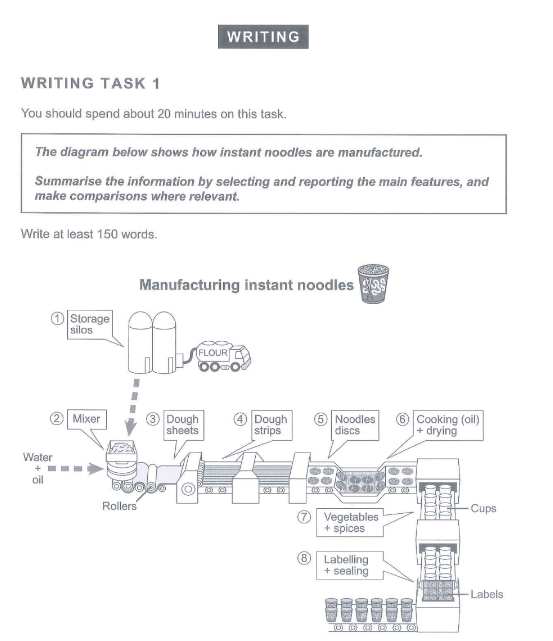
The illustration outlines the manufacturing of instant noodles.
Overall, this highly systematic machine-based process comprises 8 fundamental steps, beginning with processing flour as the main ingredient and ending with the packaging of noodles into cups for commercial sale.
At the beginning of production, flour, which is already stored in silos, is transferred to the mixing stage by truck, where it is combined with water and oil to form dough by using a specialized rectangular machine. Following this, the dough is then flattened into sheets through an extensive rolling phase. Once this particular step has been completed, these sheets are then carefully cut into fine strips to create the disc-line forms of noodles.
Thereafter, the shaped noodles discs are deep-fried, followed by a drying process to remove moisture and extend their shelf life. Once thoroughly dried, they are placed into cups and proceed to the seasoning stage, during which spices and vegetables are added. The final stage involves packing, where the cups are securely sealed, making the product ready for distribution and public sale.
|
Useful Vocabularies |
|
| The systematic machine-based process | quy trình hệ thống sử dụng nhiều máy móc |
| Flatten | ép |
| Fine strips | sợi mỏng |
| Disc-like | giống như chiếc đĩa (sử dụng hậu tố -like) |
| Deep-fry | chiên ngập dầu |
| Be placed thay cho be put | được đặt vào ly. |
| Seal | dán nhãn |
| At the beginning of production | bắt đầu |
| Following this/ Subsequently,/ Once thoroughly dried | tiếp theo |
| The final stage involves | bước cuối bao gồm |
Ngữ pháp: Chúng ta có thể bổ sung mệnh đề quan hệ ở cuối một bước để trình bày các bước tiếp theo.
Ví dụ:
At the beginning of production, flour, which is already stored in silos, is transferred to the mixing stage by truck, where it is combined with water and oil to form dough by using a specialized rectangular machine.
Once thoroughly dried, they are placed into cups and proceed to the seasoning stage, during which spices and vegetables are added.
Task 2
Some people say that advertising is extremely successful at persuading us to buy things. Other people think that advertising is so common that we no longer pay attention to it.
Discuss both these views and give your own opinion.
Give reasons for your answer and include any relevant examples from your own knowledge or experience.
Advertising plays a pivotal role in modern consumer culture, shaping purchasing decisions and influencing societal behavior. While some argue that it is highly effective in persuading individuals to buy products, others believe that its ubiquity has diminished its impact. This essay attempts to explore two views, with a personal leaning towards the former perspective.
Admittedly, the excessive presence of advertising has reversed its messages to individuals. To put it, modern customers are constantly bombarded with advertisements that appear on television, websites, billboards, and even on mobile applications. This overwhelming exposure partly leads to the fact that people simply ignore promotional messages. A case of point can be observed in the current situation, where internet users now employ ad blockers or are willing to pay premiums for ad-free experiences, reflecting a growing resistance to repetitive and uninspiring advertising campaigns.
On the other hand, despite the aforementioned drawback of advertising, I firmly hold that it remains an extremely powerful tool for promoting consumers’ buying decisions for two compelling reasons. The major one is that companies, in this day and age, invest heavily in innovative and emotionally plausible advertising, through workforce and digital marketing tools, that are designed to capture attention and elicit a response. For instance, commercials that appeal to emotions, such as family bonds or aspirational lifestyles, often convince viewers to purchase products they might not have considered otherwise. Most importantly, targeted advertising, powered by advanced algorithms, enables businesses to reach specific audiences, increasing their effectiveness. The popularity of social media platforms, for example, has revolutionized advertising, making it easier than ever to tailor ads to individuals based on their preferences and behavior. These strategies demonstrate how advertising continues to successfully drive consumer behavior.
In conclusion, while the excessive prevalence of advertising has led some individuals to disregard its messages, I believe it is an incredibly potent tool for influencing consumer behavior. Through innovative strategies and personalized approaches, advertising continues to capture attention and drive purchasing decisions effectively.
Test 4
TASK 1
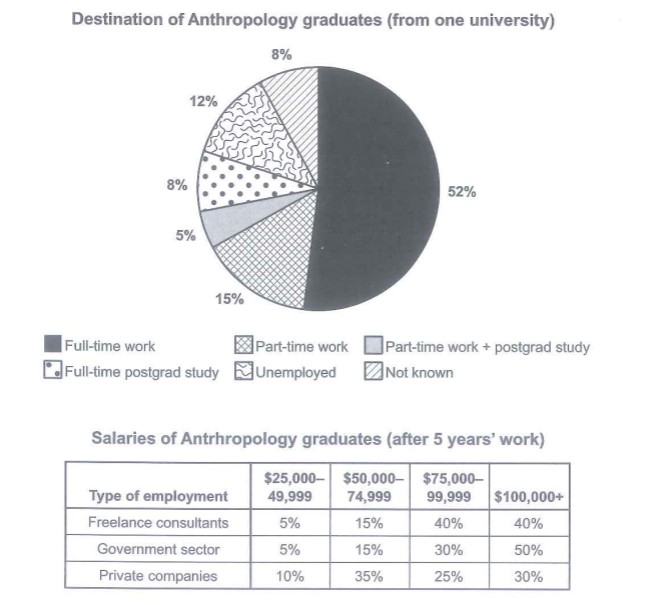
The pie chart shows what graduates with a degree in Anthropology from one university did after finishing their studies, while the table illustrates how much those who were employed earned after five years, depending on the type of job they had.
Overall, the majority of graduates found full-time work, and a much smaller percentage were unemployed or did part-time jobs. After five years, the highest salaries were seen among those working in the government and private companies.
In detail, just over half of the graduates (52%) had full-time jobs after completing their degree. Around 15% were in part-time jobs, and 12% were unemployed. Only 8% went on to full-time postgraduate study, while 5% combined work and study. The remaining 8% were in an unknown situation.
Regarding salaries after five years, 52% of those working in private companies and 50% of government employees earned more than $100,000, compared to 40% of freelancers. The percentage earning between $75,000 and $99,999 was also highest among government workers (30%), followed by freelancers (25%) and private employees (22%). Those earning under $75,000 were most common in freelance roles (35%), whereas only 20% of government workers were in this category..
(~190 words)
|
Useful Vocabularies |
|
| Illustrate | Minh họa, làm rõ |
| Graduate | Người tốt nghiệp |
| Anthropology | Nhân chủng học |
| Majority | Đa số, phần lớn |
| Employment | Việc làm, sự thuê mướn |
| Postgraduate study | Việc học sau đại học (Thạc sĩ/Tiến sĩ) |
| Regarding | Về việc, đối với |
| Freelancer | Người làm nghề tự do |
| Category | Nhóm, hạng mục, loại |
| Whereas | Trong khi đó |
| Just over half | Chỉ hơn một nửa (khoảng 51-53%). |
| Remaining | Còn lại |
| In this category | Trong nhóm này. |
TASK 2
In some cultures, children are taught that they can do anything in life if they try hard. This message can be helpful in many ways, but it may also cause some problems if not handled carefully.
One clear advantage of this idea is that it encourages children to work hard and not give up easily. When children believe that effort leads to success, they are more likely to stay focused on their goals and try their best, even when things are difficult. It also helps build their confidence, which is important when they face challenges in school or in life. For example, a student who believes in hard work might study harder and improve their grades over time.
On the other hand, this message can sometimes be too idealistic. In real life, success does not always come from effort alone. Talent, luck, or personal background can also play a big role. If children believe that hard work always leads to success, they may feel very disappointed or blame themselves when they fail, even if the failure was out of their control. This can lead to stress, frustration, or low self-esteem.
In conclusion, telling children that they can achieve anything through hard work can help them stay motivated and confident. However, it is also important to teach them that success depends on many factors, and failure is sometimes a part of life.
(~250 words)
|
Từ / Cụm từ |
Nghĩa |
|
be taught |
được dạy |
|
helpful (adj) |
hữu ích |
|
handled carefully |
được xử lý / truyền đạt một cách cẩn thận |
|
advantage (n) |
lợi ích |
|
encourage sb to do sth (v) |
khuyến khích ai làm gì |
|
give up (phr.) |
bỏ cuộc |
|
effort (n) |
nỗ lực |
|
stay focused on (phr.) |
giữ sự tập trung vào |
|
try their best (phr) |
cố gắng hết sức |
|
build confidence (phr.) |
xây dựng sự tự tin |
|
face challenges (phr.) |
đối mặt với những thử thách |
|
believe in hard work (phr.) |
tin vào sự chăm chỉ |
|
improve their grades (phr.) |
cải thiện điểm số |
|
idealistic (adj) |
lý tưởng hóa |
|
personal background (NP) |
hoàn cảnh cá nhân |
|
blame themselves (v) |
tự trách mình |
|
failure (n) |
sự thất bại |
|
out of their control (phr.) |
ngoài tầm kiểm soát |
|
stress / frustration (n) |
căng thẳng / thất vọng |
|
low self-esteem (NP) |
lòng tự trọng thấp |
|
hard work (n) |
sự chăm chỉ |
|
depends on ST (phr.) |
phụ thuộc vào cái gì
|
|
Cấu trúc |
Nghĩa |
|
If children believe that ..., they may ... |
Nếu trẻ em tin rằng ..., chúng có thể ... |
|
Even when things are difficult |
Ngay cả khi mọi thứ khó khăn |
|
This can lead to ... |
Điều này có thể dẫn đến ... |
|
For example, a student who ... might ... |
Ví dụ, một học sinh mà ... có thể ... |
|
In conclusion, ... |
Kết luận là ... |
|
It is important to teach them that ... |
Điều quan trọng là dạy các em rằng ... |
|
Not everything in life can be achieved through effort |
Không phải mọi thứ trong cuộc sống đều đạt được chỉ bằng nỗ lực |
|
Success does not always come from effort alone |
Thành công không phải lúc nào cũng đến chỉ từ sự cố gắng |
|
... even if the failure was out of their control |
... ngay cả khi thất bại nằm ngoài tầm kiểm soát của các em |
Trên đây là hướng dẫn và gợi ý bài mẫu theo đề Writing Cam 15, các bạn cùng tham khảo và tập viết bài nhé.
Xem thêm:
Tổng hợp 10+ bài mẫu IELTS Writing Task 1 Line Graph hay